

I searched something online earlier and ended up on a page about banned books. So I took a look at what books were banned or either challenged to be banned and I was appalled at the titles that overly sensitive, politically correct morons of our world feel kids in school shouldn’t read. Censoring the imagination of a child is just wrong. It’s not just kids in school who are affected but many books can no longer be sold in book stores or shelved in libraries, leaving anyone who loves to read, with empty heads, and a thirst for knowledge. That knowledge condemned because of a subject matter, or maybe a word was used because it was offensive.
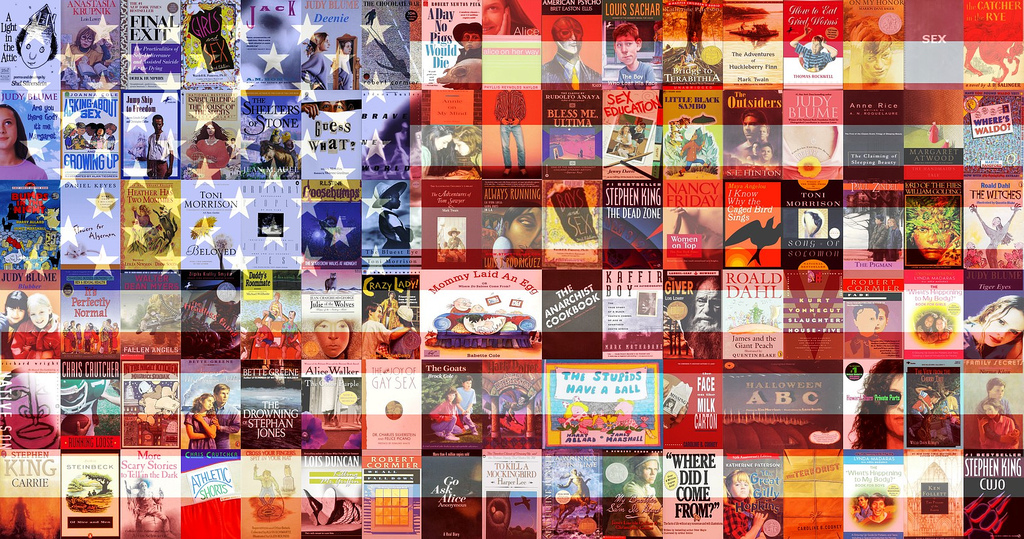
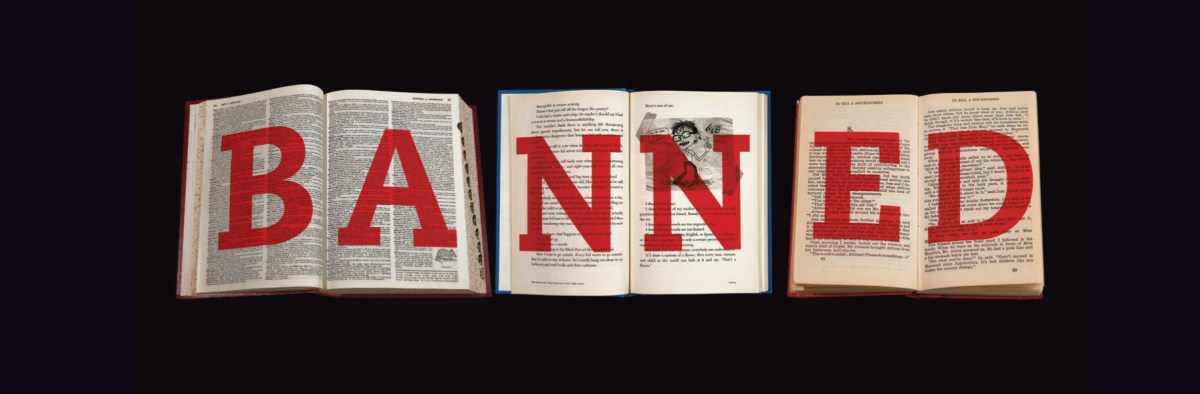
Classic novels written by the most talented authors, removed from shelves and many have been burned or placed into a box, to be stuck in some dusty broom closet forever.
What is a banned book, you ask?
A banned book is one that has been removed from the shelves of a library, bookstore, or classroom because of its controversial content. In some cases, banned books of the past have been burned and/or refused publication. Possession of banned books has at times been regarded as an act of treason or heresy, which was punishable by death, torture, prison time, or other acts of retribution.
A book may be challenged or banned on political, religious, sexual, or social grounds. We take the acts of banning or challenging a book as a serious matter, because these are forms of censorship–striking at the very core of our freedom to read.
Before a book becomes banned, someone must first challenge it. The American Library Association defines a challenge as “an attempt to remove or restrict materials, based upon the objections of a person or group.” A successful challenge results in a ban.
Book banning has existed into the farthest reaches of literary history. Socrates was charged in 399 B.C. for corrupting the minds of youth.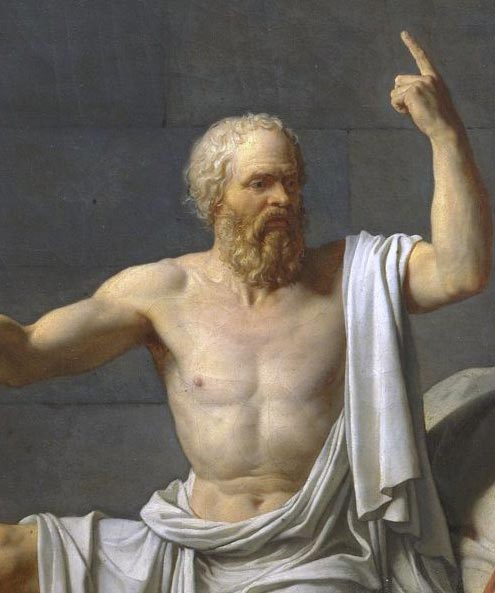
His style of teaching—immortalized as the Socratic Method—involved not conveying knowledge but rather asking question after clarifying question until his students arrived at their own understanding. He wrote nothing himself, so all that is known about him is filtered through the writings of a few contemporaries and followers, most of all, his student Plato. He was accused of corrupting the youth of Athens and sentenced to death. Choosing not to flee, he spent his final days in the company of his friends before drinking the executioner’s cup of poisonous hemlock. {http://www.history.com/topics/ancient-history/socrates}
Much of the American legal action for banning books relates to public school libraries. In 1982, the landmark case of Board of Education, Island Trees School District v. Pico found that school officials could not remove library material because they disagreed with the ideas behind it. Protecting the rights of students to express as well as receive information, the U.S. Supreme Court ruled that a book or periodical must be “pervasively vulgar” to constitute adequate ground for banning.
I love to read classic novels and books that pertain to specific histories that may have played an important part in my growing into the person who I am today. Books that told of how our ancestors, fact or fiction, lived. Stories of our home states and cities, our countries and of what makes up those countries. The history of our planets, the science of theories, of men and women who fought to make us who we see ourselves today. Many of the books that I have read in the past, have been banned today.
Sept 25, 2016, marks the beginning of the American Library Association’s annual “Banned Books Week,” a commemoration of all the books that have ever been removed from library shelves and classrooms. Banned Books Week was launched in 1982 in response to a sudden surge in the number of challenges to books in schools, bookstores and libraries. More than 11,300 books have been challenged since 1982 according to the American Library Association. There were 311 challenges reported to the Office of Intellectual Freedom in 2014, and many more go unreported.
Top ten frequently challenged books of 2014 has been released as part of the State of America’s Libraries Report:
1) The Absolutely True Diary of a Part-Time Indian, by Sherman Alexie
Reasons: anti-family, cultural insensitivity, drugs/alcohol/smoking, gambling, offensive language, sex education, sexually explicit, unsuited for age group, violence. Additional reasons: “depictions of bullying”
2) Persepolis, by Marjane Satrapi
Reasons: gambling, offensive language, political viewpoint. Additional reasons: “politically, racially, and socially offensive,” “graphic depictions”
3) And Tango Makes Three, Justin Richardson and Peter Parnell
Reasons: Anti-family, homosexuality, political viewpoint, religious viewpoint, unsuited for age group. Additional reasons: “promotes the homosexual agenda”
4) The Bluest Eye, by Toni Morrison
Reasons: Sexually explicit, unsuited for age group. Additional reasons: “contains controversial issues”
5) It’s Perfectly Normal, by Robie Harris
Reasons: Nudity, sex education, sexually explicit, unsuited to age group. Additional reasons: “alleges it child pornography”
6) Saga, by Brian Vaughan and Fiona Staples
Reasons: Anti-Family, nudity, offensive language, sexually explicit, and unsuited for age group. Additional reasons:
7) The Kite Runner, by Khaled Hosseini
Reasons: Offensive language, unsuited to age group, violence
8) The Perks of Being a Wallflower, by Stephen Chbosky
Reasons: drugs/alcohol/smoking, homosexuality, offensive language, sexually explicit, unsuited for age group. Additional reasons: “date rape and masturbation”
9) A Stolen Life, Jaycee Dugard
Reasons: drugs/alcohol/smoking, offensive language, sexually explicit, and unsuited for age group
10) Drama, by Raina Telgemeier
Reasons: sexually explicit
The top ten frequently challenged books list of 2015 will be released during National Library Week on April 10, 2016.


One of my favorite books is The Grapes of Wrath, set during the Great Depression, it focused on the Joad’s, a poor family of tenant farmers driven from their Oklahoma home by drought, economic hardship, agricultural industry changes and bank foreclosures forcing tenant farmers out of work. Due to their nearly hopeless situation, and in part because they are trapped in the Dust Bowl, the Joads set out for California, seeking jobs, land, dignity, and a future. It was brilliantly written in 1939 by John Steinbeck, was not only banned, but burned.
The book was an immediate best-seller around the country, banned and burned in a number of places, including Kern County, Calif. — the endpoint of the Joad family’s migration.
Though fictional, Steinbeck’s novel was firmly rooted in real events: Three years before the book was published a drought in the Dust Bowl states forced hundreds of thousands of migrants to California. Penniless and homeless, many landed in Kern County.
When the book came out, some of the powers that be in the county thought that they had been portrayed unfairly; they felt that Steinbeck hadn’t given them credit for the effort they were making to help the migrants. One member of the county board of supervisors denounced the book as a “libel and lie.” In August 1939, by a vote of 4 to 1, the board approved a resolution banning The Grapes Of Wrath from county libraries and schools.
One powerful local player who pushed for the ban was Bill Camp, head of the local Associated Farmers, a group of big landowners who were avid opponents of organized labor. Camp and his colleagues knew how to get a bill passed in the state Legislature — and they also knew how to be physical.
Camp wanted to publicize the county’s opposition to The Grapes Of Wrath. Convinced that many migrants were also offended by their depiction in the novel, he recruited one of his workers, Clell Pruett, to burn the book. The censorship of The Grapes Of Wrath was a key event in the creation of the Library Bill of Rights.

(Clell Pruett burns a copy of The Grapes Of Wrath as Bill Camp and another leader of the Associated Farmers stand by. At the time this photograph was taken, Pruett had not read the novel. Years later, after he read the book at the behest of Rick Wartzman, Pruett declared that he had no regrets about burning it.)
As a writer, why would I want to write a book that has a chance to end up on a banned list, because what I write may offend someone? I have the right to put onto the pages whatever the hell I feel like, just like on this blog site, or what I write on my social media pages, it’s my right as a human being to say whatever I feel. To censor me, would only piss me off and that really isn’t a wise decision. Censorship causes more problems.
We have freedoms taken for granted in a country that was built on those specific freedoms. Freedom of Speech is one of them.
What is Freedom of Speech? It is the right to communicate one’s opinions and ideas without fear of government retaliation or censorship. The term freedom of expression is sometimes used synonymously, but includes any act of seeking, receiving and imparting information or ideas, regardless of the medium used.
It is also The First Amendment to The United States Constitution, “Congress shall make no law respecting an establishment of religion, or prohibiting the free exercise thereof; or abridging the freedom of speech, or of the press; or the right of the people peaceably to assemble, and to petition the Government for a redress of grievances.”
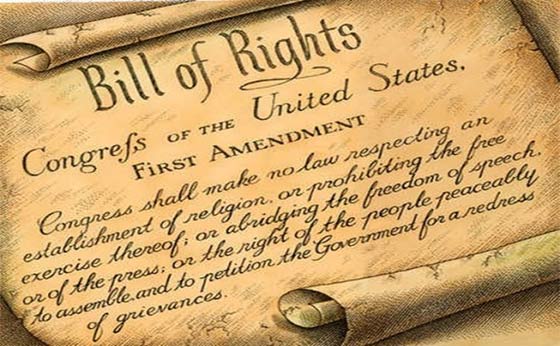
Without the First Amendment, religious minorities could be persecuted, the government might well establish a national religion, protesters could be silenced, the press could not criticize government, and citizens could not mobilize for social change. I wouldn’t be here writing this blog, we wouldn’t have the need for social media, the need for books or music, because of the words we could not use. Sometimes however, freedom of expression and speech go too far, such as allowing people to burn the American flag, or letting a group of people spew hatred towards another. They would argue that they are expressing their rights. We see this with hate groups such as the Ku Klux Klan.
Ku Klux Klan & the 1st Amendment: The Supreme Court has said that it can be protected by the 1st Amendment by having the Freedom of Speech. This depends on the the actions that is taken by that particular person. The burning of the flag can not be protected by the 1st Amendment also. This is because of the Federal Flag Protection Act of 1989. The Supreme Court decided that flag burning could be protected by political expression.
Violent speech is generally protected by the Constitution. However, the line between controversial and criminal speech has proved evasive for courts. Speech is not protected if it advocates “imminent” violent or unlawful conduct. Speech can be calculated to incite people, but not if it incites people in the wrong environment.
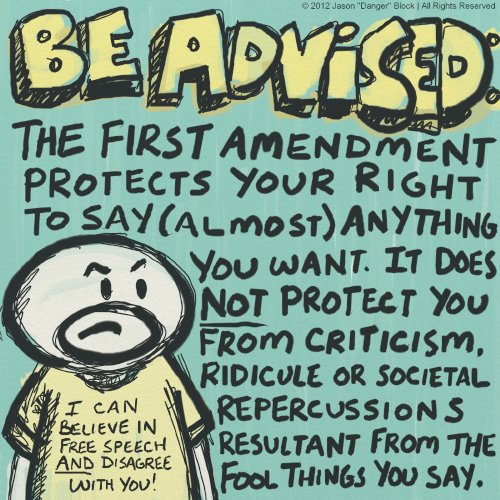
Such contradictions reflect a long history of how we deal with violent or inciteful speech. Under the Sedition Act of 1798, Congress made it a crime to “excite” people against the government or otherwise bring the government into “contempt or disrepute.” This law was used by President John Adams against critics, despite its flagrant violation of the First Amendment and condemnations by framers such as Thomas Jefferson and James Madison.
In Brandenburg v. Ohio, a KKK leader was prosecuted for giving a speech at a farm outside of Cincinnati in which he warned that “if our president, our Congress, our Supreme Court, continues to suppress the white, Caucasian race, it’s possible that there might be some re-vengeance taken.”
Clarence Brandenburg was convicted under a state law of criminal statements that proclaimed the “necessity or propriety” of acts considered violent or unlawful.
Later, in reversing the conviction, the U.S. Supreme Court held that the government could not “forbid or proscribe advocacy of the use of force or of law violation except where such advocacy is directed to inciting or producing imminent lawless action and is likely to incite or produce such actions.”
Another group of well known hate speech professionals is The Westboro Baptist Church. These people tend to picket funerals with their handmade signs of hate. They are especially known to protest at soldier’s funerals.
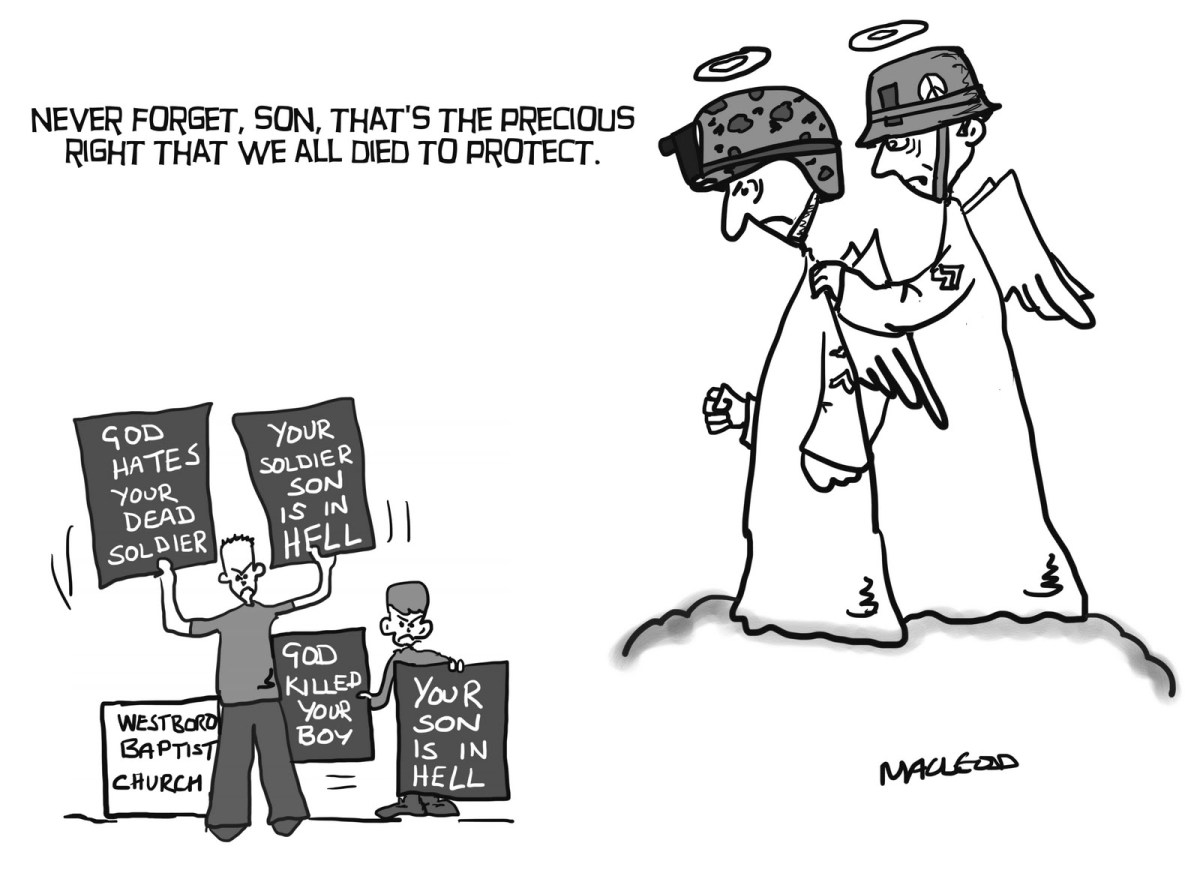
[When men and women enlist in the military, they take an oath to support and defend the Constitution, including the First Amendment, against all enemies, foreign and domestic, and affirm that they will “bear true faith and allegiance to the same.”]
Its members believe that the wars in Iraq and Afghanistan, and the attendant casualties, are divine punishment for America’s acceptance of lesbian and gay rights. They protest outside military funerals to publicize their beliefs — holding signs that say “Pray for More Dead Soldiers” and “God Killed Your Sons” — but do not cause any disruption of the funeral proper. As repellent as these protests are, they are a permissible exercise of the freedom of speech. If the First Amendment means anything, it’s that the government cannot target a group for censorship because it disagrees with the group’s message. This legislation does exactly that.


Part of living in America means putting up with words with which you not only disagree but that offend deeply. This is especially true when, as in the Westboro Baptist Church case, the words actually carry a political message.
Most people believe in the right to free speech, but debate whether it should cover flag-burning, hard-core rap and heavy-metal lyrics, tobacco advertising, hate speech, pornography, nude dancing, solicitation and various forms of symbolic speech.


This year, we are seeing proof of speeches and freedoms, within the Democratic and Republican candidates. Especially when Donald Trump is concerned. Questions have arisen in recent days about whether Donald Trump, his supporters, and his opponents have acted in ways that either violate the First Amendment or can be punished consistent with the First Amendment.

Many question The Donald’s rallies and the First Amendment, these are from various sources such as The Huffington Post, Associated Press.
Question: Can Donald Trump, consistent with the First Amendment, exclude those who oppose his candidacy from his political rallies? Answer: Yes. He is a private citizen. The First Amendment, like all provisions of the Constitution, restricts only the actions of government. Thus, just as a private person can constitutionally host a party that includes only his friends, Donald Trump can constitutionally hold a rally that includes only his supporters.
Question: Can Trump order the removal of those who oppose his candidacy from his political rallies? Answer: Yes. Just as a private person can constitutionally call the police to remove from his party those who were not invited, he can constitutionally call the police to remove from his political rallies those who oppose his candidacy. (Of course, if he does so he must pay the political price for his action.)
Question: Do opponents of Trump’s candidacy who attend a Trump rally in defiance of an announcement that attendance is limited only to his supporters have a First Amendment right to attend the event because they are engaging in a “political protest”? Answer: No. The right to protest does not include the right to trespass. As a general rule, individuals do not have a First Amendment right to violate laws having nothing to do with speech — even if they violate the law in order to engage in expressive conduct. For example, there is no First Amendment right to speed in order to get to a rally on time. There is no First Amendment right to steal a megaphone in order to speak more effectively. There is no First Amendment right to punch a policeman in order to protest police abuse. And there is no First Amendment right to trespass in order to engage in a protest.
Question: Can he order the removal of those who oppose his candidacy from his political rallies if he does not announce in advance that they are open only to his supporters? Answer: This is tricky. It does not turn on the First Amendment, but on the law of trespass. Suppose X puts up signs inviting people to come to a neighborhood party that he’s hosting in his backyard. The signs say “All Invited.” They say nothing about children. When people show up with their children, X orders them to leave, saying that he never meant for children to attend. The people with children refuse to leave, explaining that they changed their plans in order to attend the party and that it is unfair for X now to order them to leave when he did not give notice of this restriction from the outset. X calls the police. Can the police arrest for trespass the people with children who refuse to leave the party in light of the fact that the invitation to the party said nothing about excluding children? I honestly don’t know the answer to this question, but it seems clear that if Trump wants to exclude those who don’t support his candidacy from his rallies he should make that clear from the outset.
Question: Suppose Trump does not announce that people who oppose his candidacy may not attend his rallies, people who oppose his candidacy attend his rallies, and his supporters, seeing that Trump’s opponents are carrying anti-Trump signs, tear up their signs and physically assault them. Can the his supporters be arrested for destruction of private property (the signs) and assault?Answer: Yes. In such circumstances, the Trump supporters have no legal right to act in this manner. They are clearly violating the law.
Question: Suppose Donald Trump does not announce that people who oppose his candidacy may not attend his rallies, people who oppose his candidacy attend his rallies, and while there they make excessive noise and otherwise engage in behavior that is intended to disrupt the event. Can they legally be removed from the event and punished for their disruptive behavior? Answer: Yes. The First Amendment does not give individuals a right to disrupt the freedom of other individuals to hold peaceful political events.
Question: Suppose Donald Trump announces that only those who support his candidacy are invited to attend his rallies, do those who oppose his candidacy have a First Amendment right to protest outside the venue? Answer:Yes. This is at the very core of the First Amendment, which relies upon counter-speech to contest the ideas, opinions, and candidates we oppose. Such a protest must be undertaken in conformity with reasonable time, place, and manner regulations, but short of that the government has a constitutional obligation to permit such counter-speech.
Question: Can Trump constitutionally be convicted for inciting violence? Answer: No. Although Donald Trump has made statements that both encourage and endorse violence against those who have protested his candidacy, his speech in this regard is protected by the First Amendment. Over the course of half-a-century, the Supreme Court grappled with the question of when a speaker can be punished for speech that might encourage others to engage in unlawful behavior. Initially, the Court held that speech that had even a “tendency” to cause others to commit crimes could be punished. Under that now-repudiated standard, he could have been punished. But inspired by dissenting opinions by Justices Oliver Wendell Holmes and Louis Brandeis, who recognized the danger in allowing the government to punish individuals for speech that might cause others to commit crimes, the Court eventually came to the view that an individual can be punished for such speech only if he expressly incites unlawful conduct, only if that conduct is likely to occur imminently, and only if the harm caused by the unlawful conduct is very serious. The Court concluded that, except in those very rare circumstances, the government cannot constitutionally punish the speaker, but must focus its energies on punishing those who actually commit crimes. This standard has, over the years, protected a wide range of dissenters and dissidents and is essential to our contemporary understanding of the First Amendment. Under this standard, nothing Donald Trump has uttered has created a clear and present danger of criminal conduct of sufficient magnitude to merit criminal prosecution.
Question: Should he be condemned for his remarks that encourage and endorse the use of violence against those who oppose him? Answer: Absolutely. The First Amendment often protects speech that is hateful, reprehensible, and odious. The fact that speech is protected by the First Amendment does not in any way mean that it is admirable, rational, or defensible. The proper response to such speech is condemnation.
And yet Trump is supported because he speaks his mind, sometimes what comes out of his mouth could eventually land him in jail. Be funny, if he did become president that he was arrested with his hand on the bible, swearing into office but spending his days after behind the confines of bars of steel. Talk your way out of that Mr. Trump. But we know that won’t happen…him going to jail…and hopefully we won’t see him in the oval office either.
I speak my mind too, I do not hold back telling the world what I think, nothing is going to silence me, even in death, I will come back to haunt. I want to promise that…
I don’t want to be censored nor would I like to see my books (once published) banned. It’s my American right to write what is thought of inside my brain, if you are offended by it, too bad. Here is a tissue for your sensitivity.


 Mindset Overload